v2.0 is live

Always Improving Factory

ai transforms into always improving

zero-config ai development environment.
detect stack. install skills. ship code. stack agnostic.

~/my-project

$ ai-factory init

// detecting project stack...

[✓] next.js 14 + typescript detected

[✓] 20 skills installed

[✓] mcp servers configured

[✓] claude code integration ready

factory initialized. you're ready to build. ✨
// development_workflow

spec-driven. always repeatable.

ai follows a plan, not random exploration

phase_0: configuration [one-time]

$ /aif

creates project context
and skill configuration

[✓] .ai-factory/DESCRIPTION.md

[✓] .ai-factory/ARCHITECTURE.md

[✓] .ai-factory/ROADMAP.md

[✓] .ai-factory/RULES.md

[✓] AGENTS.md

[✓] skills + mcp configured

development_loop [repeatable cycle]

01

// planning

$ /aif-roadmap

$ /aif-plan [fast|full]

$ /aif-improve

strategic milestones, detailed task
breakdowns, dependency refinement

02

// execution

$ /aif-implement

$ /aif-fix

tasks with commit checkpoints,
patches for self-improvement

04

// evolve

$ /aif-evolve

analyzes accumulated patches,
improves skill capabilities

03

// quality assurance

$ /aif-verify [--strict]

$ /aif-loop

validates against plan, reflex loop:
PLAN → PRODUCE → EVALUATE → REFINE

planimplementverifycommitevolve

// new_project_workflow

from zero to production

complete step-by-step guide for any new project

setup [one-time]
01

$ npm i -g ai-factory

install ai-factory globally

02

$ ai-factory init

detect stack, install skills, configure mcp servers

03

open your ai agent

claude code, cursor, windsurf — any supported agent

04

$ /aif

initialize project structure and primary configuration

planning [critical]
05

write your requirements

the most important step. think it through carefully.
use llm to refine and structure your spec

[!] quality of output = quality of input

06

$ /aif-roadmap

decompose requirements into milestones with clear deliverables

development_loop [repeat per milestone]
[~] clear context between steps — each step generates all the context the next one needs. fresh context = better results
07

$ /aif-plan

plan milestone — create branch, detailed tasks, dependencies

08

$ /aif-improve

refine the plan — fix gaps, verify dependencies

[optional but recommended]

09

$ /aif-implement

execute task by task with commit checkpoints

10

$ /aif-verify

validate: everything done, nothing forgotten

11

$ /aif-fix

problems? fix them

or

$ /aif-commit

all good? commit

12

merge to main

return to main branch, merge the feature

next milestone — repeat from step 07

// why_workflow

more tokens now. less pain later.

structured workflow costs more upfront but saves exponentially over time

without workflow

token usage

"cheap" start, expensive rewrites

after feature

manually update docs, ci, contracts, configs

context

agent forgets decisions between sessions

bug fixing

re-explain everything from scratch each time

quality

random results, no verification step

automation

set up manually or forget about it

with ai-factory

token usage

invest in planning, save on rewrites and fixes

after feature

docs, ci, contracts, automation — updated in the cycle

context

persistent specs: roadmap, plan, architecture

bug fixing

/aif-fix reads the plan and knows what was intended

quality

/aif-verify checks every task before commit

automation

ci, docker, build scripts — generated and maintained

spend ~20% more tokens on planning save ~60% on fixes, rewrites, and context recovery

// core_features

built for the way you work

> _

zero config

detects your stack automatically. no yaml, no json, no setup files. just works.

[ ]

spec-driven dev

ai follows structured plans. predictable, resumable, and reviewable workflows.

++

multi-agent

works with claude code, cursor, windsurf, copilot, gemini cli, and 10+ more agents.

$ /

skill ecosystem

leverage skills.sh marketplace. community-built extensions with security scanning.

{✓}

best practices

built-in logging, commit conventions, code review, and doc generation.

[!]

security first

two-level security scanning for all external skills. safe by default.

// supported_agents

works with your favorite ai

one factory, 15+ compatible agents

claude code
cursor
windsurf
roo code
github copilot
gemini cli
kilo code
opencode
warp
zencoder
junie
+and more...

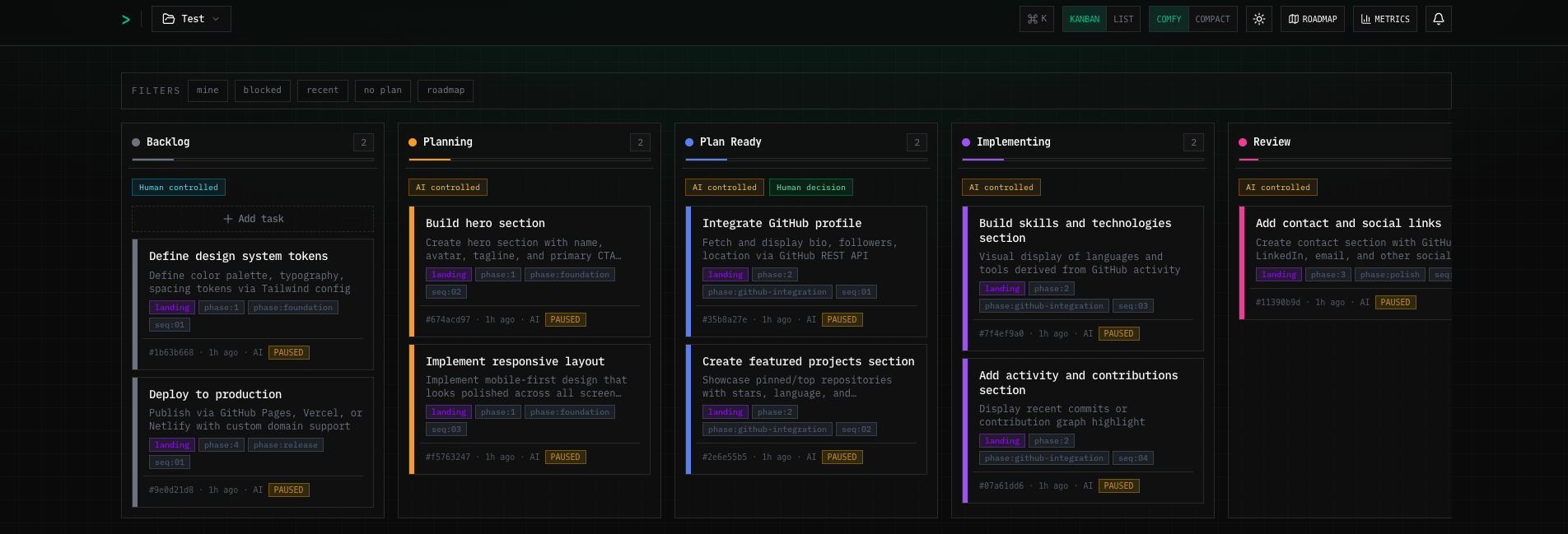
// aif_handoff

autonomous kanban. zero oversight.

create a task — ai plans, implements, and reviews it. fully autonomous pipeline built on ai-factory.

backlog
planning
plan ready
implementing
review
done

full autopilot

drop a task in backlog — ai plans it, writes the code, reviews its own work, and ships. no babysitting required.

agent orchestration

specialized coordinators for each stage. plan-polisher refines specs. parallel workers execute. review sidecars validate.

self-healing loops

heartbeat monitoring, automatic recovery from stuck stages, and rework loops when review catches issues.

kanban + list views

beautiful ui with drag-and-drop board, list view, real-time websocket updates, dark and light themes.

layer-aware execution

detects task dependencies automatically and dispatches parallel workers across independent layers.

two execution modes

subagents mode for iterative refinement and higher quality. skills mode for fast single-pass execution.

Handoff kanban board — dark theme

built on ai-factory. powered by claude agent sdk.

// faq

frequently asked

+ i need to sync additional docs beyond what ai-factory provides. how?

use $ /aif-rules and add a rule like "after implementation, update API_REFERENCE.md and CHANGELOG.md". rules are executed automatically after each implementation cycle — so you never forget to keep your custom docs in sync.

+ doesn't the workflow use too many tokens?

planning takes ~20% more tokens upfront. but without a plan, agents waste tokens on wrong approaches, context recovery, and rewrites. structured workflow pays for itself within the first 2-3 features.

+ can i use ai-factory with an existing project?

yes. run $ ai-factory init in any project — it detects your stack, installs relevant skills, and configures mcp servers. existing code stays untouched. you get the workflow on top of what you already have.

+ what if the agent makes a mistake during implementation?

$ /aif-verify catches missed tasks and deviations from the plan. if something is wrong — $ /aif-fix reads the plan and knows exactly what was intended. each feature runs on a separate branch, so main stays clean.

+ do i have to follow every step in the workflow?

no. the workflow is modular — skip what you don't need. small fix? just $ /aif-fix and $ /aif-commit. big feature? use the full cycle. the only step that's always recommended is $ /aif-verify before commit.

+ what about microservices or separate frontend and backend?

initialize ai-factory separately in each service — backend, frontend, every microservice gets its own $ ai-factory init with its own description, architecture, and skills. then add shared rules via $ /aif-rules describing how services communicate: api contracts, event schemas, shared types. each agent works in its own context but follows the same integration rules.

stop configuring.
start building.

join 200+ developers using ai-factory to supercharge their workflow

200+github stars
|
15+ai agents
|
20+skills
|
MITlicense