Zero Config
Detects your stack automatically. No YAML, no JSON, no setup files. Run init in any project — new or existing — and the environment is ready.
ai transforms into always improving
Zero-config AI development environment. Detects your stack, installs skills, configures agents — then drives a spec-driven loop that plans, implements, verifies and evolves.
The development loop
/aif-plan · /aif-improve
One command triggers planning. A milestone becomes a branch, detailed tasks and dependencies — refined for gaps before a single line is written.
/aif-implement · /aif-fix
Tasks execute one by one with commit checkpoints. When something breaks, the fix command reads the plan and knows exactly what was intended.
/aif-verify · /aif-qa · /aif-loop
Every task is validated against the plan, then a three-stage QA pipeline produces a risk-annotated change summary, test plan and concrete test cases. The reflex loop refines until it passes.
/aif-evolve
Accumulated patches are analyzed and folded back into skill capabilities. The factory gets measurably better with every cycle you run.
Detects your stack automatically. No YAML, no JSON, no setup files. Run init in any project — new or existing — and the environment is ready.
AI follows a plan, not random exploration. Persistent specs — roadmap, architecture, rules — make every workflow predictable, resumable and reviewable.
Claude Code, Cursor, Windsurf, Copilot, Codex, Gemini CLI, Antigravity, Roo Code, Warp, Junie and more. One workflow, any agent your team already uses.
Two-level security scanning for every external skill from the skills.sh marketplace. Community-built extensions, safe by default.
/aif-qa runs a three-stage manual-testing workflow: risk-annotated change summary, scoped test plan, and concrete TC-NNN test cases — artifacts saved per branch.
/aif-distillation turns books, docs, folders or URLs into reusable Agent Skills — workflows, heuristics, checklists and examples instead of a long summary. Split mode builds a whole toolkit.
Structured workflow costs ~20% more upfront on planning — and saves ~60% on fixes, rewrites and context recovery.
Without workflow
With AI Factory
The complete path for any new project. Clear context between steps — each step generates everything the next one needs.
Run this once in a repository to install AI Factory and create the shared project context.
Turn requirements into clear milestones before implementation starts.
Repeat this loop for every milestone until the work is verified and ready to merge.
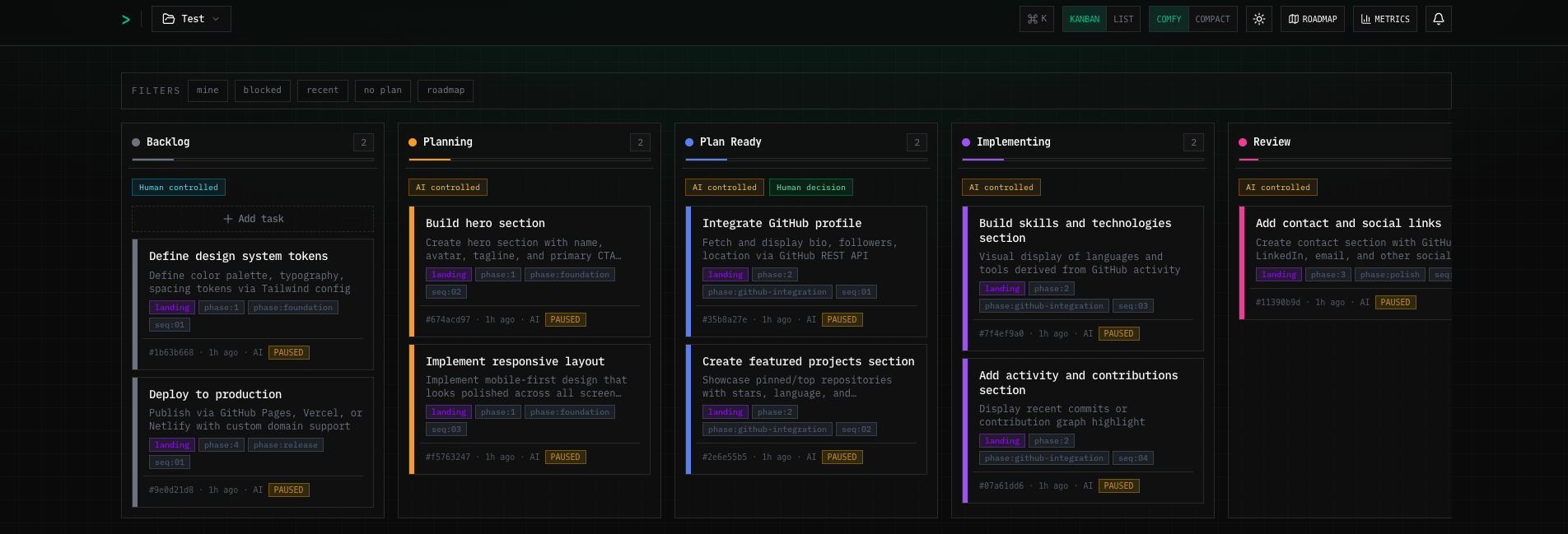
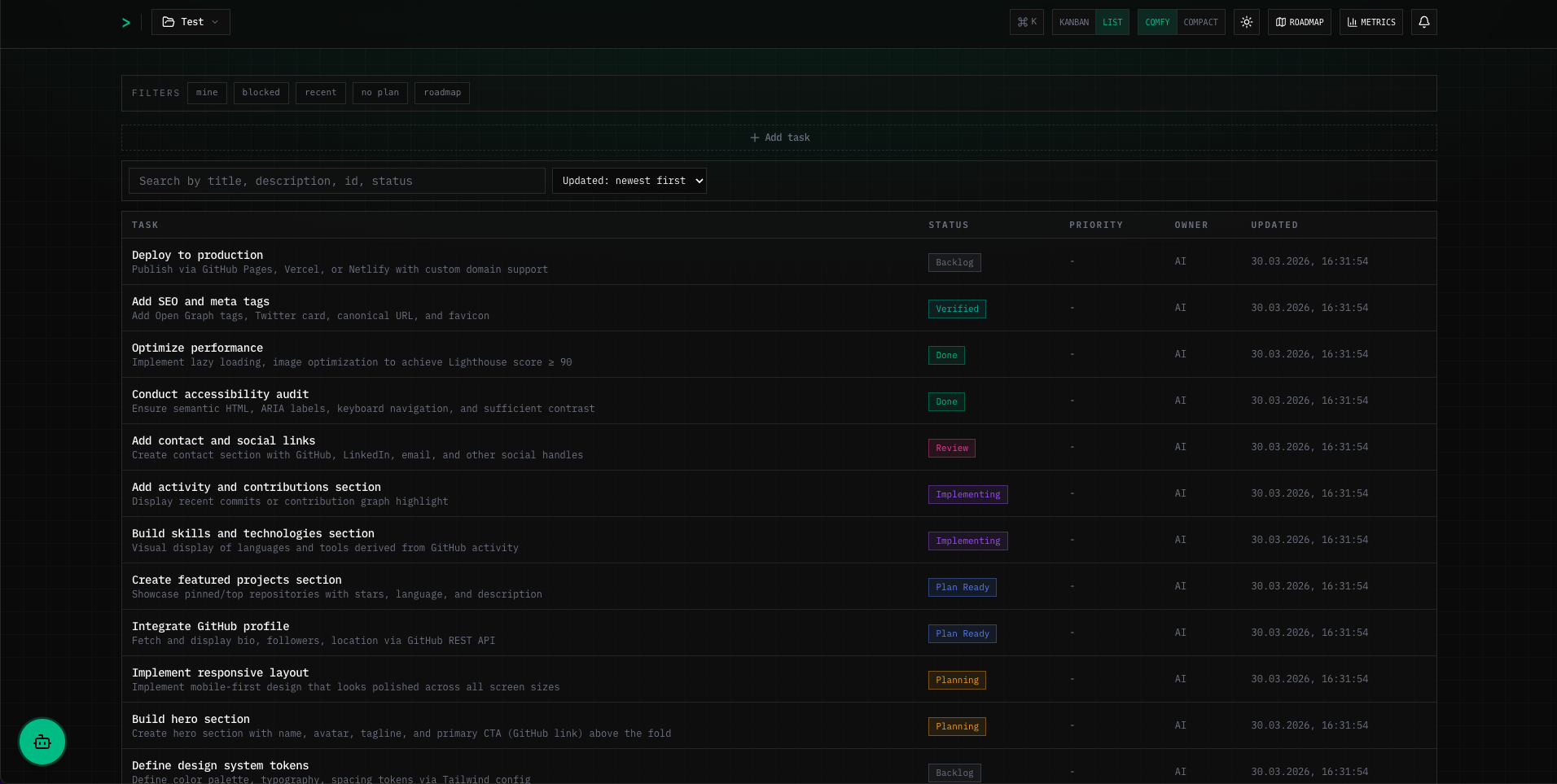
Create a task — AI plans, implements and reviews it. A fully autonomous pipeline built on AI Factory and the Claude Agent SDK: agent orchestration, self-healing loops, layer-aware parallel execution, real-time board.
Live task pipeline
Planning takes ~20% more tokens upfront. But without a plan, agents waste tokens on wrong approaches, context recovery and rewrites. The structured workflow pays for itself within the first 2–3 features.
Yes. Run ai-factory init in any project — it detects your stack, installs relevant skills and configures MCP servers. Existing code stays untouched. You get the workflow on top of what you already have.
/aif-verify catches missed tasks and deviations from the plan. If something is wrong — /aif-fix reads the plan and knows exactly what was intended. Each feature runs on a separate branch, so main stays clean.
No. The workflow is modular — skip what you don't need. Small fix? Just /aif-fix and /aif-commit. Big feature? Use the full cycle. The only step that's always recommended is /aif-verify before commit.
Initialize AI Factory separately in each service — every microservice gets its own init with its own description, architecture and skills. Then add shared rules via /aif-rules describing how services communicate: API contracts, event schemas, shared types.
Use /aif-rules and add a rule like “after implementation, update API_REFERENCE.md and CHANGELOG.md”. Rules run automatically after each implementation cycle — your custom docs never drift.
Join 1000+ developers shipping with AI Factory.