Development Workflow
AI Factory has two phases: configuration (one-time project setup) and the development workflow (repeatable loop of explore → plan → improve → implement → verify → commit → evolve).
User decisions follow the runtime-aware question contract: use the current session's supported tool/schema, fall back to plain text when needed, and return unresolved required decisions from autonomous workers to their caller.
Extensions and runtime adapters can explicitly register an invocation with ai-factory instructions to preserve its instruction composition and load reports. This is opt-in and does not alter ordinary skill execution. See Instruction Manifests for capture policy, provenance limits, and verification.
Project Configuration
Run once per project. Sets up context files that all workflow skills depend on.
During /aif, the initial .ai-factory/config.yaml is created from the commented template, and setup reruns refresh only the managed keys so manual comments and unrelated customizations survive.
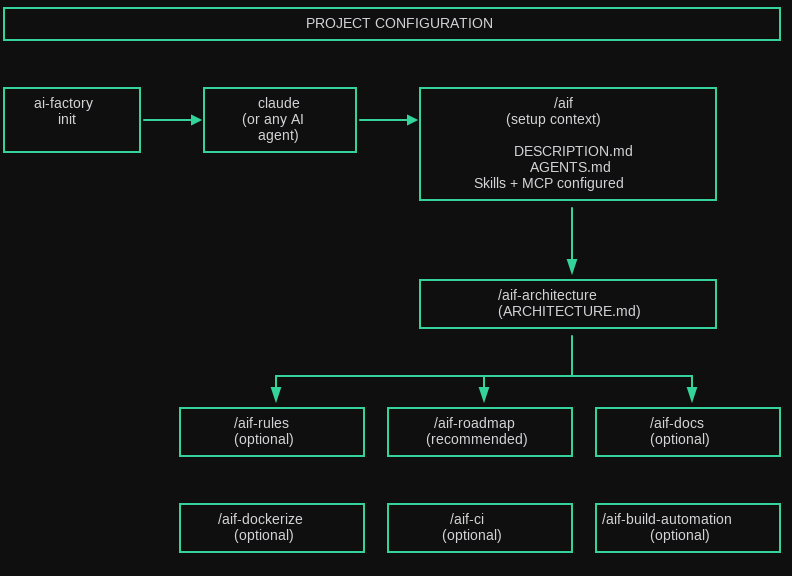
Text version
┌────────────────────────────────────────────────────────────────────────────────────────────────┐
│                                     PROJECT CONFIGURATION                                      │
└────────────────────────────────────────────────────────────────────────────────────────────────┘


┌────────────────┐       ┌──────────────────┐       ┌────────────────────────────────────┐
│   ai-factory   │       │      claude      │       │                /aif                │
│      init      │──────▶│    (or any AI    │──────▶│          (setup context)           │
│                │       │      agent)      │       │                                    │
└────────────────┘       └──────────────────┘       │           DESCRIPTION.md           │
                                                    │             AGENTS.md              │
                                                    │      Skills + MCP configured       │
                                                    └────────────────────────────────────┘
                                                                       │
                                                                       │
                                                                       │
                                                                       ▼
                                                    ┌────────────────────────────────────┐
                                                    │         /aif-architecture          │
                                                    │         (ARCHITECTURE.md)          │
                                                    └────────────────────────────────────┘
                                                                       │
                                                                       │
                                  ┌─────────────────────────┬──────────┴──────────────┐
                                  ▼                         ▼                         ▼
                      ┌──────────────────────┐  ┌──────────────────────┐  ┌──────────────────────┐
                      │      /aif-rules      │  │     /aif-roadmap     │  │      /aif-docs       │
                      │      (optional)      │  │    (recommended)     │  │      (optional)      │
                      └──────────────────────┘  └──────────────────────┘  └──────────────────────┘


                      ┌──────────────────────┐  ┌──────────────────────┐  ┌──────────────────────┐
                      │    /aif-dockerize    │  │       /aif-ci        │  │/aif-build-automation │
                      │      (optional)      │  │      (optional)      │  │      (optional)      │
                      └──────────────────────┘  └──────────────────────┘  └──────────────────────┘
Development Workflow
The repeatable development loop. Each skill feeds into the next, sharing context through plan files and patches.
Path examples below show the default .ai-factory/ locations. config.yaml can relocate plan, fix, reference, security, patch, evolution, loop, and qa artifacts while keeping the same ownership flow.
Optional discovery step: use /aif-explore before planning to investigate ideas, compare options, and clarify requirements.
Before choosing build/test/verification commands, planning and implementation can read the project command catalog. Select an exact declaration and working directory; discovery neither runs a command nor proves it runnable. Ambiguities and source changes require a fresh decision.
Session startup: use /aif-warmup to load the core project artifacts, applicable instructions, and optional extra files/directories from warmup.paths into a compact handoff before choosing the next workflow command. The warmed session can then continue directly or be forked.
Reliability gate: use /aif-grounded when the main problem is not discovery but certainty - high-stakes answers, changeable facts, version-sensitive behavior, or any request where the model must refuse to guess.
If you want exploration results to survive /clear and feed directly into planning, ask /aif-explore to save them to paths.research (default: .ai-factory/RESEARCH.md). Use explicit /aif-explore ultra <topic> for a named bundle with mandatory INDEX.md + compatible RESEARCH.md and only the C4, ADR, or dependency artifacts justified by the topic. See Research and System Analysis.
Before presenting any persisted regular or ultra update, /aif-explore re-reads
the saved research and checks that its Active Summary is self-contained and does
not silently contradict durable findings. This coherence gate uses a fresh-context
subagent where available and the same direct check everywhere else.
Optional conventions step: use /aif-rules to append or refine project-wide axioms in paths.rules_file, or /aif-rules area:<name> to create or update <configured rules dir>/<area>.md and register rules.<area> in .ai-factory/config.yaml. Downstream workflow skills resolve rules with the same hierarchy: rules.<area> > rules/base.md > paths.rules_file.
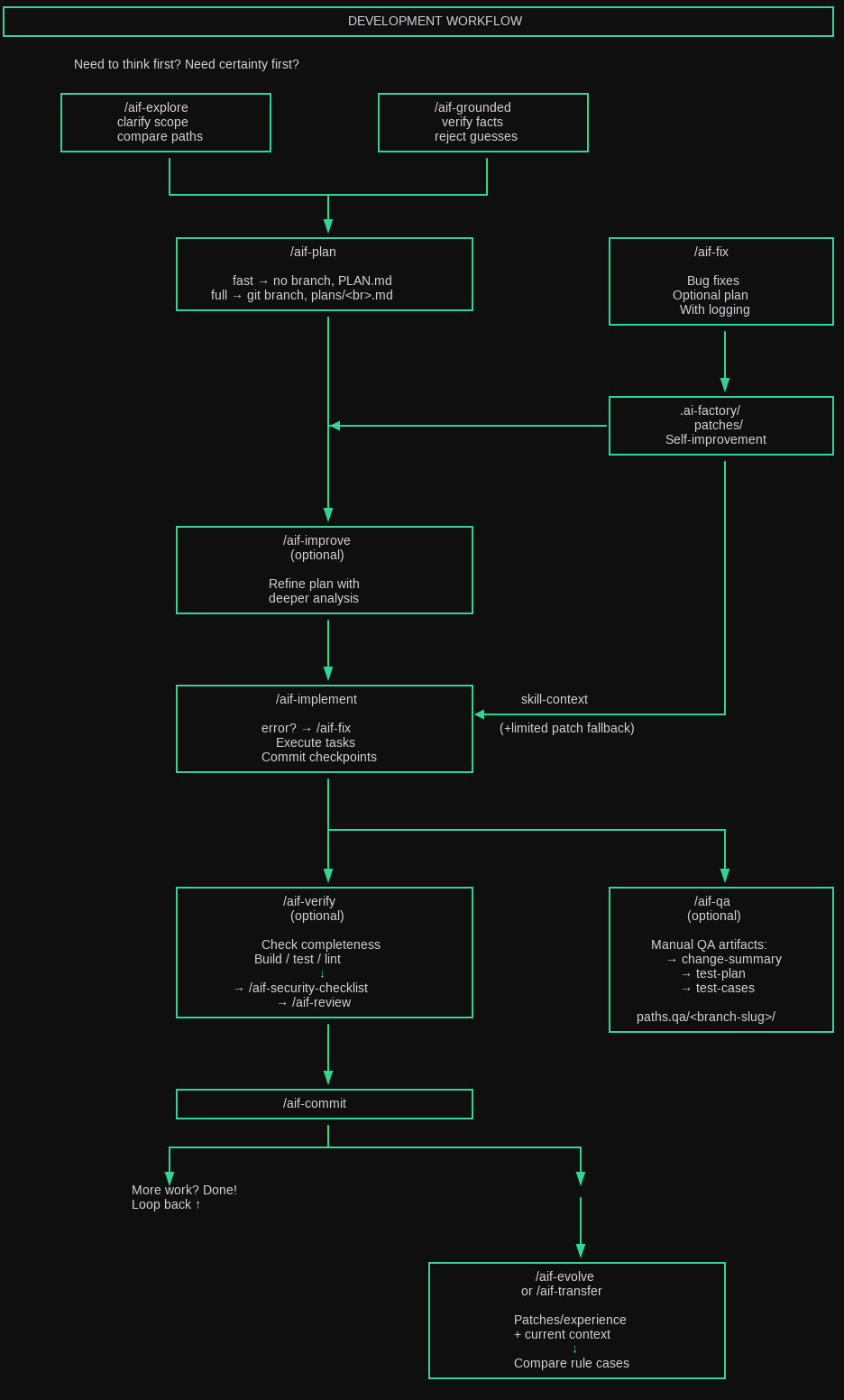
Text version
┌──────────────────────────────────────────────────────────────────────────────────────────────────────────────────┐
│ DEVELOPMENT WORKFLOW │
└──────────────────────────────────────────────────────────────────────────────────────────────────────────────────┘
Need to think first? Need certainty first?
┌────────────────────────────┐ ┌────────────────────────────┐
│ /aif-explore │ │ /aif-grounded │
│ clarify scope │ │ verify facts │
│ compare paths │ │ reject guesses │
└────────────────────────────┘ └────────────────────────────┘
│ │
│ │
└─────────────────────┬─────────────────────┘
│
▼
┌────────────────────────────────────────┐ ┌──────────────────────────────┐
│ /aif-plan │ │ /aif-fix │
│ │ │ │
│ fast → no branch, PLAN.md │ │ Bug fixes │
│ full → git branch, plans/<br>.md │ │ Optional plan │
└────────────────────────────────────────┘ │ With logging │
│ └──────────────────────────────┘
│ │
│ │
│ │
│ ▼
│ ┌──────────────────────────────┐
│ │ .ai-factory/ │
├◀─────────────────────────────────────│ patches/ │
│ │ Self-improvement │
│ └──────────────────────────────┘
│ │
│ │
│ │
▼ │
┌────────────────────────────────────────┐ │
│ /aif-improve │ │
│ (optional) │ │
│ │ │
│ Refine plan with │ │
│ deeper analysis │ │
└────────────────────────────────────────┘ │
│ │
│ │
│ │
▼ │
┌────────────────────────────────────────┐ │
│ /aif-implement │ skill-context │
│ │◀─────────────────────────────────┘
│ error? → /aif-fix │ (+limited patch fallback)
│ Execute tasks │
│ Commit checkpoints │
└────────────────────────────────────────┘
│
│
│
├──────────────────────────────────────────────────────┐
│ │
│ │
▼ ▼
┌────────────────────────────────────────┐ ┌──────────────────────────────┐
│ /aif-verify │ │ /aif-qa │
│ (optional) │ │ (optional) │
│ │ │ │
│ Check completeness │ │ Manual QA artifacts: │
│ Build / test / lint │ │ → change-summary │
│ ↓ │ │ → test-plan │
│ → /aif-security-checklist │ │ → test-cases │
│ → /aif-review │ │ │
└────────────────────────────────────────┘ │ paths.qa/<branch-slug>/ │
│ └──────────────────────────────┘
│
│
▼
┌────────────────────────────────────────┐
│ /aif-commit │
└────────────────────────────────────────┘
│
┌─────────────────────┴──────────────────────────────────┐
│ │
▼ ▼
More work? Done!
Loop back ↑ │
│
│
▼
┌────────────────────────────────────────┐
│ /aif-evolve │
│ or /aif-transfer │
│ │
│ Patches/experience │
│ + current context │
│ ↓ │
│ Compare rule cases │
└────────────────────────────────────────┘
When to Use What?
Two read-only advisors support the existing loop:
/aif-roadmap-next → user selects scope → /aif-plan → /aif-plan-overview → /aif-implement
The first recommends ready, unclaimed roadmap work within an estimated mode capacity; the second explains the existing plan and planned file changes. Neither mutates project artifacts. Planning begins only after the user selects a scope and start.
| Command | Use Case | Creates Branch? | Creates Plan? |
|---|---|---|---|
/aif-warmup |
Load essential project context at session start or before a fork | No | No |
/aif-explore |
Discovery, option comparison, and requirements clarification before planning | No | No (optional paths.research on request) |
/aif-explore ultra |
Durable system analysis with adaptive C4/ADR/dependency coverage | No | No (creates <parent(paths.research)>/research/<english-slug>/) |
/aif-grounded |
Evidence-only answers, strict verification, and high-stakes questions where guessing is unacceptable | No | No |
/aif-roadmap |
Strategic planning, milestones, long-term vision | No | paths.roadmap (default: .ai-factory/ROADMAP.md) |
/aif-roadmap-next |
Choose the next ready roadmap scope, accounting for dependencies and active plans | No | No (optional separate /aif-plan handoff after selection) |
/aif-plan-overview |
Explain a fast/full/ultra/fix plan and its declared file map | No | No |
/aif-rules |
Capture project conventions or add area-specific rules before planning and implementation | No | No (paths.rules_file or paths.rules/<area>.md) |
/aif-plan fast |
Small tasks, quick fixes, experiments | No | paths.plan (default: .ai-factory/PLAN.md) |
/aif-plan full |
Full features, stories, epics | Optional (git.enabled + git.create_branches) |
paths.plans/<branch-or-slug>.md (or paths.plans/<NNNN>_<branch-or-slug>.md when workflow.plan_id_format: sequential — see Plan Files) |
/aif-plan ultra |
Large/cross-cutting work delegated from a strong planner to a smaller implementer | Optional (git.enabled + git.create_branches) |
paths.plans/<id>/index.md + one detailed file per phase |
/aif-plan full|ultra --parallel |
Concurrent features via worktrees | Yes + worktree (git.enabled + git.create_branches) |
Autonomous end-to-end |
/aif-improve |
Refine plan before implementation | No | No (improves existing) |
/aif-loop |
Iterative generation with quality gates and phase-based cycles | No | No (uses paths.evolution, default .ai-factory/evolution/) |
/aif-reference |
Create knowledge refs from URLs/docs for AI agents | No | No (paths.references, default .ai-factory/references/) |
/aif-distillation |
Turn books, docs, folders, or URLs into one reusable Agent Skill or a split set of focused skills | No | No |
/aif-fix |
Bug fixes, errors, hotfixes | No | Optional (paths.fix_plan, default .ai-factory/FIX_PLAN.md) |
/aif-transfer |
Reuse anonymized prevention lessons from a similar AI Factory project through /aif-evolve |
No | No |
/aif-rules-check |
Standalone read-only rules compliance gate for staged work, working tree, or a git ref | No | No (reads existing rules and optional plan context) |
/aif-verify |
Post-implementation quality check | No | No (reads existing) |
/aif-qa |
Manual QA for a feature/fix: change summary → test plan → test cases | No | paths.qa/<branch-slug>/*.md (default: .ai-factory/qa/<branch-slug>/) |
/aif-qa-check |
Execute QA cases manually or through automated agent checks | No | paths.qa/<branch-slug>/qa-check.md and browser replay scripts; agent mode also maintains paths.qa/agent-context.md and paths.qa/agent-history.md |
/aif-archive |
Archive completed plans and trim closed roadmap milestones | No | paths.archive/plans/*, paths.archive/roadmap/*.md (default: .ai-factory/archive/) |
/aif-qa change-summary normally derives context from git diffs. When git.enabled=false or the target/base refs cannot be resolved locally or through origin/<base_branch>, it asks for manual change context instead of failing on git commands.
/aif-qa-check consumes the resulting test-cases.md; human mode asks for one result at a time, and agent mode uses the appropriate execution surface for each case: browser, CLI, API, automated tests, or file/document checks.
Browser/UI cases still require live browser execution, preferring the in-app Browser and falling back to Playwright MCP.
Their dependency-free replay scripts are reused only when case, approved-target, and proven-content digests match; a new or changed script runs once as proof, while stateful repeat execution requires restored preconditions and renewed authorization.
Original scripts/errors are preserved before repair, and selector failures remain product failures unless only locator mechanics demonstrably changed. Replay is followed by a recorded decision to run or skip one bounded exploratory pass based on concrete change-risk signals, so saved scripts do not become the only source of browser coverage. Non-browser cases are not blocked merely because browser automation is unavailable.
Agent mode reads agent-context.md and agent-history.md first, asks the user for missing recoverable execution context before blocking, records only reusable non-sensitive cross-QA facts in those root-level files, and offers human-mode continuation only for human-verifiable blocked cases. Run-specific details stay in branch-specific qa-check.md.
QA check results are bound to the tested commit plus worktree digest, or to a manual build identifier when git is unavailable, plus source/case/replay digests, so stale passes are not counted after the branch, dirty working tree, target, replay script, or test cases change.
Artifact Ownership and Context Gates
Ownership is command-scoped to avoid conflicting writers:
| Command | Primary artifact ownership | Notes |
|---|---|---|
/aif |
.ai-factory/DESCRIPTION.md, setup AGENTS.md |
invokes /aif-architecture for architecture file |
/aif-architecture |
paths.architecture (default: .ai-factory/ARCHITECTURE.md) |
may update architecture pointer in DESCRIPTION/AGENTS |
/aif-roadmap |
paths.roadmap (default: .ai-factory/ROADMAP.md) |
/aif-implement may mark completed milestones |
/aif-rules |
paths.rules_file (default: .ai-factory/RULES.md), paths.rules/<area>.md, rules.<area> |
top-level axioms plus area-rule files and registration |
/aif-plan |
paths.plan, full paths.plans/<id>.md, ultra paths.plans/<id>/ |
/aif-improve refines existing plans/bundles |
/aif-explore |
regular paths.research; ultra <parent>/research/<english-slug>/ |
ultra always has INDEX.md + RESEARCH.md; supporting files are conditional |
/aif-reference |
paths.references/*, paths.references/INDEX.md |
knowledge references from external sources |
/aif-distillation |
current agent skills directory by default, or --path <directory> as an output root (<root>/<skill-name>/, or prefixed child dirs in --split mode) |
distilled skills from explicit source material |
/aif-fix |
paths.fix_plan, paths.patches/*.md |
bug-fix learning loop artifacts |
/aif-evolve |
paths.evolutions/*.md, paths.evolutions/patch-cursor.json, .ai-factory/skill-context/* |
skill-context overrides + evolution logs + cursor state; verified user-owned target files after approval |
/aif-transfer |
delegates approved writes to /aif-evolve; no source or patch ownership |
source read-only; current patches and cursor untouched |
/aif-qa |
paths.qa/<branch-slug>/change-summary.md, test-plan.md, test-cases.md |
derived branch slug as subdirectory (see aif-qa SKILL.md) |
/aif-qa-check |
paths.qa/<branch-slug>/qa-check.md, paths.qa/<branch-slug>/browser-replay/, paths.qa/agent-context.md, paths.qa/agent-history.md |
executes /aif-qa test cases; canonical and preserved replay scripts provide target/content-bound evidence; source QA artifacts stay read-only |
/aif-archive |
paths.archive/plans/*, paths.archive/roadmap/*.md |
moves completed plan files/bundles from paths.plans/; trims closed milestones from paths.roadmap |
/aif-rules-check |
read-only context by default | standalone rules gate; no default context-file writes |
/aif-warmup |
read-only context | loads a compact session handoff; writes nothing |
/aif-commit /aif-review /aif-verify |
read-only context by default | gate and report, no default context-file writes |
Context-gate defaults for /aif-commit, /aif-review, /aif-verify:
- Check architecture, roadmap, and rules alignment as read-only context.
- Missing optional files (
ROADMAP.md,RULES.md) areWARN, not immediate failures. - In strict verification, clear architecture/rules violations and clear roadmap mismatch are blocking failures.
/aif-rules-checkis the standalone rules-only companion and uses humanPASS/WARN/FAILlabels./aif-verify,/aif-review,/aif-security-checklist, and/aif-rules-checkappend a final machine-readableaif-gate-resultJSON block with lowercasepass/warn/failstatus values. See Quality Gates.
Workflow Skills
The setup, implement, verify, and fix entrypoints select their detailed references by mode. Load the selected procedure before its step; do not read every reference at startup. Mode boundaries, artifact ownership, ultra marker checks, regression-first fallbacks, and exact handoffs remain mandatory. Missing selected references stop the dependent step. See selective workflow references for installation details and reproducible footprint measurements.
These skills form the development pipeline. Each one feeds into the next.
/aif-explore [regular|ultra] [topic or plan name] — discovery before planning
/aif-explore real-time collaboration
/aif-explore the auth system is getting unwieldy
/aif-explore add-auth-system
/aif-explore ultra partner order synchronization
Thinking-partner mode for exploring ideas, constraints, and trade-offs without
implementing code. Reads resolved context plus relevant active plan artifacts.
If you want the context to persist after /clear, save it to paths.research.
Ultra mode, selected explicitly or through workflow.explore_mode: ultra,
persists an English-slug topic bundle. A leading regular overrides the default.
Ultra always writes a manifest INDEX.md and plan-compatible RESEARCH.md, then adds C4 views, ADRs,
or a dependency graph only when evidence crosses their inclusion thresholds.
Ultra additionally checks that Active Summary claims have self-contained bundle
support and material supporting conclusions are reflected back into the summary.
When direction is clear, transition to /aif-plan fast, full, or ultra.
On explicit request, exploration can also track source-linked project
hypotheses inside RESEARCH.md. Accepted experiment inputs pass through the
same Active Summary and Research Context; implementation completion remains
separate from measured outcomes. Execution uses a separately authorized task
and existing runner. See Optional Project Hypotheses
for cards, provenance, and revision-bound results.
/aif-grounded [question or task] — certainty before action
/aif-grounded Does this repo already support feature flags?
/aif-grounded Which command should I use if I need a fully verified answer?
Reliability-gate mode for evidence-backed answers. Use it when the task is already clear but the answer must be strictly verified: high-stakes requests, version-sensitive facts, current-state questions, or any prompt that says "no assumptions". Unlike /aif-explore, it is not for brainstorming or open-ended trade-off mapping; it either answers from evidence with Confidence: 100/100 or stops with INSUFFICIENT INFORMATION and tells you what is missing.
/aif-roadmap [check | vision] — strategic planning
/aif-roadmap                              # Create or update roadmap
/aif-roadmap SaaS for project management  # Create from vision
/aif-roadmap check                        # Auto-scan: find completed milestones
High-level project planning. Creates paths.roadmap (default: .ai-factory/ROADMAP.md) — a strategic checklist of major milestones (not granular tasks). Use check to automatically scan the codebase and mark milestones that appear done. /aif-implement also checks the roadmap after completing all tasks.
/aif-plan [fast|full|ultra] <description> — plan the work
/aif-plan Add user authentication with OAuth       # Uses config, otherwise asks which mode
/aif-plan fast Add product search API              # Quick plan, no branch
/aif-plan full Add user authentication with OAuth  # Full plan; branch is optional
/aif-plan ultra Rebuild billing around a ledger    # Multi-file, implementation-complete plan
/aif-plan full --parallel Add Stripe checkout      # Parallel worktree
Three modes — fast (quick single file), full (rich single file), and
ultra (a directory whose index.md owns scope/progress and whose phase files
specify implementation in code-level detail). Full and ultra share testing,
logging, docs, roadmap, branch, and worktree preferences.
In every mode, an explicitly
selected milestone group is persisted as Milestone: plus Also completes: lines;
completion checks each linked milestone separately, and archived completed plans
with open roadmap links remain pending reconciliation. Sequential IDs put
NNNN_ on the full filename or ultra directory and count active full files plus
directories whose index.md contains the stable ultra marker.
A leading mode token overrides workflow.plan_mode. With its default ask,
omitting the mode preserves the full/fast question (fast in non-interactive
Handoff mode). Ultra requires a leading ultra token or workflow.plan_mode: ultra.
See Command defaults.
If the description comes from a research Active Summary, keep the resolved mode
(including configured ultra) without asking for the mode again.
Ultra discovery uses the exact untranslated
<!-- aif:plan-mode:ultra --> entrypoint marker, so artifact localization cannot
change bundle recognition.
All modes preserve an explicit Original Request; research-backed plans commit
a revisioned Research Context. Ultra additionally requires exact paths and
symbols, ordered edits, contracts, errors/logging, test policy, acceptance
criteria, verification, and bundle-integrity checks so a smaller model does not
have to reconstruct architecture. See Plan Files.
/aif-improve [--list] [+check|--no-check] [@plan-file-or-directory] [prompt] — refine the plan
/aif-improve
/aif-improve --list
/aif-improve +check
/aif-improve @my-custom-plan.md
/aif-improve @.ai-factory/plans/feature-billing
/aif-improve add validation and error handling
Second-pass analysis. Finds missing tasks, fixes dependencies, removes redundant work, and reports useful-but-out-of-scope ideas. Discovery priority is explicit file/ultra directory, branch-based full/ultra artifact, single named artifact, fast plan, then fix plan.
Ultra refinement reads and updates index.md plus all
linked phase files as one bundle, preserves task progress in the index, and
reruns link/task/dependency integrity checks. Original Request stays verbatim;
revisioned Research Context remains committed scope and drift produces
WARN [research-drift]. --list is read-only.
Optional +check (also enabled by workflow.improve_check: true, overridden
for one invocation with --no-check) runs a single fresh-context review-validator with a runtime-enforced Read, Glob, Grep allowlist on the refinements (missing / improvements / removals / out_of_scope groups), drops invented items, rewrites partially-correct ones, and appends Hidden by +check / Adjusted by +check counters to the Step 5 Summary block. Dependency fixes are recomputed against the filtered list after validation.
If that allowlist is unavailable or unenforced (including Codex), no validator is dispatched: findings stay unchanged, counters are omitted, and WARN [+check] explains the limitation. There is no full-tool fallback.
Combined with --list, validation flags and the configured default are silently ignored — there is no refinement to validate.
/aif-loop [new|resume|status|stop|list|history|clean] [task or alias] — iterative quality loop
/aif-loop new OpenAPI 3.1 spec + DDD notes + JSON examples
/aif-loop resume
/aif-loop status
/aif-loop list
/aif-loop history courses-api-ddd
/aif-loop clean courses-api-ddd
Runs a strict Reflex Loop with 6 phases: PLAN -> PRODUCE||PREPARE -> EVALUATE -> CRITIQUE -> REFINE. PRODUCE and PREPARE run in parallel via Task tool; EVALUATE runs check groups in parallel.
Before iteration 1, it always asks for explicit confirmation of success criteria, max iterations, and a non-none time budget (even if they are already in task text).
Keeps one active loop pointer under paths.evolution/current.json and per-task run state in paths.evolution/<alias>/run.json with append-only events in history.jsonl and latest output in artifact.md.
Stops by a fixed precedence contract — threshold_reached, no_major_issues, user_stop, stagnation, budget_exceeded, iteration_limit (default max iterations: 4) — where the optional soft budget (run.json.max_completed_phase_seconds) is checked at phase boundaries only, never interrupts a running phase, and counts completed segments alone.
If loop stops on max iterations or the time budget without passing criteria, final summary includes distance-to-success metrics (threshold gap + remaining blocking fail-rules). Use list to see all loop runs, history to view events, clean to remove old loop runs.
For full contracts and state transition rules, see Reflex Loop.
/aif-implement — execute the plan
/aif-implement        # Continue from where you left off
/aif-implement --list # Show available plans only (no execution)
/aif-implement @my-custom-plan.md # Execute using an explicit plan file
/aif-implement @.ai-factory/plans/feature-billing # Execute an ultra bundle
/aif-implement 5      # Start from task #5
/aif-implement status # Check progress
Reads skill-context rules first, then uses limited recent patch fallback when
needed. Executes tasks one by one with commit checkpoints. Discovery supports an
explicit plan file or ultra directory, branch/single named full or ultra
artifact, fast plan, then fix-plan redirect. For ultra, it reads the complete
phase file before executing a task and updates progress only in index.md.
Original Request supplies original scope; committed Research Context supplies
revisioned requirements. --list is read-only. Docs policy remains
Docs: yes → mandatory /aif-docs checkpoint; no/unset → WARN [docs].
Within an authorized /aif-docs task, the optional
technical writing profile can edit selected
documentation/runbooks after their language is fixed. It is disabled by default
and preserves meaning and project terminology before improving readability.
It adds no requirements-validation or quality gate to this workflow.
When executing through the Claude top-level implement-coordinator, the quality-gate sidecars include review-sidecar, security-sidecar, and rules-sidecar (aif-rules-check) after code changes, plus best-practices-sidecar for maintainability checks. In Handoff automation, HANDOFF_SKIP_REVIEW=1 intentionally skips the review-family gates: review-sidecar, security-sidecar, and rules-sidecar.
/aif-verify [--strict] — check completeness
/aif-verify          # Verify implementation against plan
/aif-verify --strict # Strict mode — zero tolerance for gaps
Optional step after /aif-implement. Goes through every task in the plan and verifies the code actually implements it.
If the plan contains Original Request, /aif-verify uses it as original scope context while the task list and committed Research Context remain the executable verification inputs. If the plan references RESEARCH.md, /aif-verify verifies against the embedded Research Context and checks the exact legacy or bundled source only for revision drift.
Checks build, tests, lint, looks for leftover TODOs, undocumented env vars, and plan-vs-code drift. If gaps are found, it first suggests /aif-fix <issue summary> (recommended). If verification is clean, it suggests /aif-security-checklist and /aif-review. Use --strict before merging to the configured base branch.
Also runs read-only context gates against the resolved architecture, roadmap, and RULES.md artifacts. In normal mode, roadmap/milestone linkage gaps are warnings; in strict mode, clear roadmap mismatch is a failure, while missing feat/fix/perf milestone linkage remains a warning. The final output appends an aif-gate-result JSON block for orchestrators.
/aif-rules-check — standalone rules gate
Checks only rules compliance for staged changes, working-tree changes, or a provided git ref. It reads the resolved rules hierarchy, uses optional active plan context only to disambiguate scope, and stays read-only. Human verdicts are PASS / WARN / FAIL: missing or ambiguous rules stay WARN, while FAIL is reserved for explicit hard-rule violations tied to concrete diff evidence. The final output appends an aif-gate-result JSON block with lowercase pass / warn / fail.
/aif-review [PR number or URL] [+check] — code review with read-only context gates
Explicit +check is driven by the shared executable host protocol in CHECK-MODE.md. Its source → internal reviewer → validator → gate sequence is exercised offline by npm run test:review-check, also included in npm test, using deterministic tool responses and versioned reports. Replay maintenance describes the recording format and failure checks.
Protocol v3 independently collects config and description at the pinned head before Reviewer. A nonempty excerpt and its file record must match that independent result, including the description path resolved from pinned config; Reviewer-supplied content and hashes alone cannot establish provenance; an unavailable description is recorded explicitly and retains source uncertainty. Validator blocks with missing, blank, or duplicate Reason keep the original finding and emit a warning.
Reviews staged changes or PR diff and reports correctness/security/performance findings. Includes read-only architecture/roadmap/rules gate notes in review output (WARN for non-blocking inconsistencies, ERROR only for explicitly blocking criteria), then appends an aif-gate-result JSON block.
For application API changes, the API compatibility reference adds a bounded comparison of supported contract revisions and actual consumers. It separates wire compatibility from semantics and preserves the existing findings, validation, source and gate contracts.
In PR mode, the review and validator share one source package bound to full base/head/merge-base SHAs and the exact diff hash. Additional code and versioned context artifacts come from that tree without switching branches.
Review Sources lists file versions, local discrepancies, unavailable context and PR freshness. Missing evidence remains a visible limitation (warn at minimum), including empty-item runs and validation failure; actionable hypotheses retain the existing confidence-marker lifecycle. See the review reference and source package contract.
The finding stage is coverage-first: it reports uncertain and low-severity findings instead of pre-filtering them. Severity picks the section by impact, and confidence is carried separately as a (confidence: low) / (confidence: medium) marker on the item text.
A marker never reaches the published gate: a review that produced at least one marker runs the +check validation automatically, even when the flag was not given. Each marked finding is either confirmed — returned without the marker and counted as an ordinary finding of its section, so a confirmed critical is a blocker and drives fail — or refuted and dropped.
The aif-gate-result block is computed from the post-validation findings, so it never encodes an unverified potential blocker (warn plus suggested_next.command: null).
If the pass fails to resolve a marker — a contract-violating or malformed validator response for that item, or a whole-dispatch failure while markers are present — the gate reports the failure itself rather than a verdict: status: fail, blocking: true, a review-validation-failed blocker, the unresolved findings excluded from blockers, and suggested_next.command: null with a reason to re-run /aif-review +check; a WARN [+check] line names the cause.
Optional +check runs a single fresh-context review-validator subagent — on Claude Code the bundled agent allowlisted to Read, Glob, Grep; on Codex a read-only-sandbox agent without a tool allowlist — on the drafted findings (Critical Issues and Suggestions only): drops invented items, rewrites partially-correct ones in place, and may reclassify items between the two severity levels — promote a suggestion to "Critical Issues" when the cited behavior is actually merge-blocking, or demote a critical finding to "Suggestions" when the framing was too harsh.
Severity definitions and the promotion/demotion rules live in skills/aif-review/references/SEVERITY.md. The rendered review gains a final line Filtered: N hidden, M adjusted, K reclassified by +check.
The aif-gate-result block is rebuilt after filtering — from the surviving findings merged with the unchanged context-gate result, so a failing context gate keeps status at fail even when no Critical Issues remain; suggested_next is recomputed (/aif-commit when no blockers remain; otherwise /aif-fix, or the failing gate's own command — /aif-rules, /aif-architecture, /aif-roadmap — when a single context gate is the sole blocker).
If the validator call fails entirely the unfiltered review is kept and a single WARN [+check] line is appended above the aif-gate-result block (which always stays last); a marker-free review then keeps its pre-validation gate, a review with markers publishes the review-validation-failed gate described above.
A run that markers made automatic takes that same failure path when review-validator is not installed or its runtime does not enforce the tool allowlist (Codex), rather than falling back to a weaker boundary — the prompt carries the reviewed diff verbatim, and an unflagged run must not let the reviewed content reach a wider tool set than the review itself had.
/aif-commit — conventional commit with read-only context gates
Creates conventional commits from staged changes and runs read-only architecture/roadmap/rules checks before finalizing the message.
When an active plan contains ## Commit Plan, it can use the planned commit groups first; for ultra plans it reads the relevant phase files and maps group tasks through Files to Change plus the task specifications.
Unmapped staged files trigger a question before staging or committing, and no commit plan leaves staged-diff behavior unchanged. If the same file spans multiple groups, /aif-commit must use hunk-level staging or stop before changing staging. Whole-file staging is allowed only when grouped files do not overlap unstaged worktree paths.
By default this remains warning-first (no implicit strict mode). For feat/fix/perf commits, missing roadmap milestone linkage is reported as warning.
/aif-fix [bug description] — fix and learn
/aif-fix TypeError: Cannot read property 'name' of undefined
Two modes — choose when you invoke:
- Fix now — investigates, applies the Canonical Regression-First Policy when needed, fixes with logging, then reruns the same regression check when available
- Plan first – creates
paths.fix_planwith analysis and fix checklist, then stops for review
The Canonical Regression-First Policy is defined in skills/aif-fix/SKILL.md.
When a plan exists, run without arguments to execute:
/aif-fix # reads the configured fix plan → applies fix → deletes only default FIX_PLAN.md
After successful execution, /aif-fix deletes only the default .ai-factory/FIX_PLAN.md; custom/non-default fix plan files are preserved.
If a fix plan references RESEARCH.md, /aif-fix executes against the embedded Research Context and checks the exact legacy or bundled source only for revision drift.
Every fix creates a self-improvement patch in paths.patches (default: .ai-factory/patches/). Patches improve future workflow runs primarily through /aif-evolve (which distills them into .ai-factory/skill-context/*).
/aif-evolve — improve skills from experience
/aif-evolve          # Evolve project skills only
/aif-evolve fix      # Evolve only the fix skill
/aif-evolve all --global # Only existing user-global skills
First resolves canonical skill targets and installation ownership. Project built-ins use skill-context; verified user-owned skills use their exact approved paths.
Shared project layers load global → build (fix/implement/plan/verify/improve only) →
individual, with individual taking precedence. Project all evolution can consolidate
rules only after validating every affected consumer; named runs stay individual.
See Shared Evolution and Consolidation.
Extension-managed and unknown targets are skipped. Global user-owned edits require
--global and approval stating their cross-project reach; global built-ins are skipped.
See Skill Ownership and Write Destinations.
Reads patches incrementally using an evolve cursor, analyzes project patterns, and creates rule candidates. Each candidate is compared with the current effective instructions on the same original case, counterexample, and relevant regressions, with extra cost recorded.
Only an exact revision with demonstrated benefit and no detected regression is offered for user approval. Narrowed/refined rules require another comparison; missing execution evidence means postpone.
Logs preserve negative results, including "the new rule did not improve behavior", without adding those instructions to active skill-context. See Comparing Rule Candidates.
/aif-skills-audit — inspect the installed library
Run /aif-skills-audit explicitly to review overlaps, stale instructions and context
growth across built-in, extension and third-party skills. Its report starts with
final composition and explains the dependencies and surviving duty owners for any
merge/removal candidate. Missing usage observations mean not measured, never
useless.
The audit applies no recommendations and executes no audited skills or commands.
Output stays in chat unless --output "<new-report.md>" is supplied; --online
enables read-only external checks. See the audit reference.
/aif-transfer — reuse anonymized experience
/aif-transfer /path/to/reference-project
/aif-transfer /path/to/reference-project fix
Reads another AI Factory project's patches as untrusted, read-only evidence, keeps only
prevention points supported by the current project, removes source identity, then runs
the installed /aif-evolve workflow. Raw patches are never copied, the current evolve
cursor is not changed, and privacy is checked before and after approved writes.
For full details on all skills including utility commands (/aif-docs, /aif-dockerize, /aif-build-automation, /aif-ci, /aif-commit, /aif-rules-check, /aif-skill-generator, /aif-distillation, /aif-reference, /aif-security-checklist, /aif-qa, /aif-qa-check), see Core Skills.
Why Spec-Driven?
- Predictable results - AI follows a plan, not random exploration
- Resumable sessions - progress saved in plan files, continue anytime
- Commit discipline - structured commits at logical checkpoints
- No scope creep - AI does exactly what's in the plan, nothing more
See Also
- Research and System Analysis — adaptive ultra research bundles
- Core Skills — detailed reference for all workflow and utility skills
- Plan Files — how plan artifacts are stored and managed